So, I clicked “submit” on the last question of the final exam a couple of hours ago, and I'm satisfied to note I have an overall 92% grade. But was it a good course?
Ooh, let's rewind a bit. This course is supposed to be many things, an introduction to the world of genomic, or precision, medicine for the layman as well as for medical students. In eight short weeks, we get maybe a dozen different people giving short lectures about their particular field, all in relation with genomic medicine. The lectures are arranged in four themes, which are broadly the clinic, the lab, business, and ethics. Dr Haddad, the main instructor, introduces everybody and conducts Q&A sessions, in order for the course not to feel too disjointed.
So, a success? Partly. The production is good, although maybe they've overdone it a bit. Before each video segment we have a full page of text explaining the pedagogical objectives of the segment. Big instructions in bold remind us to use the navigation bar to, erm, navigate the course. And so on. It feels somewhat dumbed-down.
The course content is, obviously, varied. Generally I liked the clinic theme and was bored with the other three (the lab one was very introductory). Although they emphasize that medical students may be watching the videos, in truth − I guess medical students have better things to do. The overall level of the course is very, very basic. Apart from a tidbit here and there (I wasn't aware of fluorescent in-situ hybridization), I can't say I have learned much during the course, and only stuck with it because it's summer and I had nothing better to do.
Hmm… I may sound too harsh. Let's say that if you approach this course as you would, say, one from MIT, then you'll be disappointed. Which is not to say there isn't merit; the team have made a good attempt at surveying the landscape of genomic medicine, primarily from doctors' points of view, and deliver something akin to an Internet-era pop-science book, and a pretty decent one at that.
So, would I recommend this course? Not generally, not to people with a utilitarian view of MOOCs, who measure success in skills and knowledge acquisition. But to specific people, maybe to people who're simply curious, who've heard about sequencing the genome, maybe about the recent judicial issues surrounding 23andMe, and who are willing to spend a couple of hours a week to find out more about it, yeah. Definitely.
Showing posts with label edx. Show all posts
Showing posts with label edx. Show all posts
Wednesday, July 30, 2014

Monday, July 21, 2014
Quantitative biology workshop, MIT
MIT's 7.QBW's winding down. I'm not sure what to think about it.
On the one hand, it's nice to get to grips with some biological problems with the tools actual computational biologists use. As usual, MIT do things seriously, the syllabus is impressive, the lectures are great and stimulating, etc.
On the other hand, it's very frustrating − we only get to lightly touch on to some very basic concepts. I can't really say I've learned anything of substance; most of the “workshops” have been, by necessity, hobbled by the idea that primarily biologists would take the course, with little to no competence in computer programming. And so, to review a number of languages and tools in a very short time, everything is kept very basic, very introductory. Only once so far was there a really interesting problem (the MATLAB one on neurological analysis).
A quick trawl through the forums show that basically there are two populations − the biologists who find the programming assignments very hard, and the programmers who breeze through the course and are frustrated not to do more biology.
I guess the course's ambition makes it a bit of a tightrope exercise; maybe the MOOC format isn't so well suited to that kind of course? I guess people would have found it more satisfying if the course had been either an applied programming crash course for biologists, or a biology application aimed at software people. Then, by excluding one half of the prospective population, they could have gone deeply enough to teach actual skills and knowledge to the other half.
On the third hand, by applying standard expectations, we are reading this wrong. It's not a “course” and it's not meant to teach skills'n'knowledge. It's a workshop, based on an outreach program. It's aimed at giving people a glimpse of what can be done in the field of computational biology − and in that respect, I'd say it's pretty well hit the nail on the head.
But then again, it's pretty frustrating to get a glimpse of something cool and not have any way to reach towards it. If MIT created a systems biology course or sequence of courses, then this workshop would be the best possible introduction to it. On its own, it's kinda… unfinished.
PS oh, yeah, of course, I'm going to ace the course. But for the reasons explained above, I have no real merit in it.
Update 2014-08-02: yay, here's my certificate:
 (Yes, I shelled out for the Verified cert, because it goes some way towards contributing to edX and MIT, and mostly because there are rumours that MIT Biology are considering creating an XSeries − then have verified certs in likely courses is a good way to get a leg up.)
On the one hand, it's nice to get to grips with some biological problems with the tools actual computational biologists use. As usual, MIT do things seriously, the syllabus is impressive, the lectures are great and stimulating, etc.
On the other hand, it's very frustrating − we only get to lightly touch on to some very basic concepts. I can't really say I've learned anything of substance; most of the “workshops” have been, by necessity, hobbled by the idea that primarily biologists would take the course, with little to no competence in computer programming. And so, to review a number of languages and tools in a very short time, everything is kept very basic, very introductory. Only once so far was there a really interesting problem (the MATLAB one on neurological analysis).
A quick trawl through the forums show that basically there are two populations − the biologists who find the programming assignments very hard, and the programmers who breeze through the course and are frustrated not to do more biology.
I guess the course's ambition makes it a bit of a tightrope exercise; maybe the MOOC format isn't so well suited to that kind of course? I guess people would have found it more satisfying if the course had been either an applied programming crash course for biologists, or a biology application aimed at software people. Then, by excluding one half of the prospective population, they could have gone deeply enough to teach actual skills and knowledge to the other half.
On the third hand, by applying standard expectations, we are reading this wrong. It's not a “course” and it's not meant to teach skills'n'knowledge. It's a workshop, based on an outreach program. It's aimed at giving people a glimpse of what can be done in the field of computational biology − and in that respect, I'd say it's pretty well hit the nail on the head.
But then again, it's pretty frustrating to get a glimpse of something cool and not have any way to reach towards it. If MIT created a systems biology course or sequence of courses, then this workshop would be the best possible introduction to it. On its own, it's kinda… unfinished.
PS oh, yeah, of course, I'm going to ace the course. But for the reasons explained above, I have no real merit in it.
Update 2014-08-02: yay, here's my certificate:
Wednesday, July 2, 2014
Human sacrifice as a scientific technique
Actual test-yourself question from Astrophysics 2 - Exoplanets:

Which only proves the vital necessity for observatories of procuring a regular supply of fresh grad students.
That said, it's a nice illustration of why I like this course: there's serious stuff in there, but they don't forget their sense of humour. Another question asked whether the vibrations caused by nearby kangaroos jumping up and down might cause blurred spectral lines…
Wednesday, June 11, 2014
Worth Sticking To? Genomic Medicine Gets Personal, Georgetown University
We're now in Week Two of this course, and getting to grips with the actual content. As a reminder, this course from Georgetown University is about the transformative aspects of “genomics” as a whole with regards to the theory and practice of medicine.
In other words, while I've been studying basic biology, bioinformatics, epigenetics, etc., from a purely intellectual point of view, this course takes a different approach, grounded on the experiences of doctors counseling actual patients. Which is all and well, only… well, the actual science is too basic. I am not certain I can actually be bothered to listen to people explain that there are 22 pairs of autosomes, or what a mutation is. So while the point of view is certainly interesting, at this stage I am not quite certain it is enough to keep me interested. We'll see; but in the meantime, this course is in the uncomfortable position of the one I am most likely to drop.
In other words, while I've been studying basic biology, bioinformatics, epigenetics, etc., from a purely intellectual point of view, this course takes a different approach, grounded on the experiences of doctors counseling actual patients. Which is all and well, only… well, the actual science is too basic. I am not certain I can actually be bothered to listen to people explain that there are 22 pairs of autosomes, or what a mutation is. So while the point of view is certainly interesting, at this stage I am not quite certain it is enough to keep me interested. We'll see; but in the meantime, this course is in the uncomfortable position of the one I am most likely to drop.
Starting: 7.QBWx Quantitative Biology Workshop
Let's see… 7.00x Introduction to Biology got me hooked on to MOOCs. I've been assiduously taking courses in biology / medicine ever since, as well as computing courses and bioinformatics ones. So, when 7.QBWx was announced − a hands-on, workshop-oriented, introduction to the realm of “quantitative biology” (i.e. bridging the gap between data scientists and biologists), from the great people at MIT (were it not for the unfortunate Social Physics Buy-My-Book-Please-But-Let's-Pretend-It's-A-Course, I'd believe that MIT is the place where the exceptionally deserving go to when they die) − well, what could I do − except end this rambling sentence?
While the official start date was yesterday, the course hasn't really started − we've only been given a handful of introductory tasks to complete, basically checking that we could install all the necessary software on our computers. The real stuff begins next week. In the meantime, my freshly-updated Linux Mint is now equipped with R, Canopy Python (on top of system Python), Octave, and PyMOL.
I am slightly apprehensive: how can a 6-week workshop covering so many different tools and languages actually achieve any significant learning outcomes? The only way I can see is to make the course pretty hard − I'm not worried: by now I have a decent enough biology background, and of course I've been a professional programmer for 15 years, so I doubt I'll struggle in this course − which is my worry, really: if I don't struggle, how am I going to actually learn stuff?
Well, we'll see. I am fairly confident the great people at MIT (where the exceptionally deserving, etc.) have assembled a challenging, great course, and am eager to see what it comes to.
On a side note, a staff member (pseudonymed TurtlesAllTheWayDown, which − as a long-time Pratchett fan − I find absolutely wonderful) has admitted that an MIT Biology XSeries is at least being discussed. I am incredibly excited about this − and will therefore probably upgrade to Verified Certificate after next week, if it appears the course is really worthwhile, so as to make it count towards the future, possible XSeries.
Thursday, May 22, 2014
I guess I should have studied Astrophysics…
… as my final grade for the ANU ASTRO1x course is, well, reasonably good.

(That said, the grading scheme was rather lenient. While I do know a lot more about astronomy than I used to, I don't really deserve a 100% score. But still, it's always nice to get good grades.)
(That said, the grading scheme was rather lenient. While I do know a lot more about astronomy than I used to, I don't really deserve a 100% score. But still, it's always nice to get good grades.)
Saturday, May 17, 2014
Stat2.2X is passed!
So, I can do Probabilities.

To be honest, I didn't think I'd get this one − I mean, I joined on the third week of a five-week course (so I'd missed 40% of the course); worse, there was a midterm on the second week which I'd already missed. I registered anyway, because I wanted to learn about the subject (I am still convinced that statistics and probabilities are the most important maths one should learn at school after arithmetic) and because I intend to take 2.3X, “Inference”.
But thanks to the grading scheme (50% of the grade is contributed by the final alone, plus only the four best homework assignments, out of five, count towards the grade) I made it. Since edX have adopted the policy of handing out certificates to everyone, that's my, let's see, 11th edX certificate secured.
(I made a grand total of 2 errors in the course; both of which I could have avoided if I'd paid a little attention.)
Wednesday, May 14, 2014
EdX's enrollment options
At edX, when you enroll on a course, you pick your track between two options… although there are often, in reality, three. Let's review them:
- “Audit” is the most basic. Gives you access to the courseware, the exams, etc. but you don't get a certificate of completion should you “pass” the course − what it means is, you don't feel the pressure to do exams (which can actually be detrimental to the learning process). It's free.
- “Honour code” (or “Honor” as they write it, but hey, I'm European and half-Brit) is the basic certificate-granting level. You do everything, then if you do well you get a nice little PDF saying that someone purporting to be you completed the course. It's also free.
- “Verified Certificate” means that you send official proof of your identity (in fact you hold up your passport to your webcam, you take a picture of yourself with the same webcam, someone at edX matches the pictures. You may have to take additional pictures at random times during the course to prove it's still you, but that's not happened to me yet.) So the PDF now says that someone took the course and they did check it was you. There's a fee involved, which is decided on a per-course basis. The cheaper courses start at $25 a pop, and I've seen courses asking for ten times that. Besides, that's a minimum fee − remember, edX is a nonprofit. When you pick the Verified Certificate track, you can pay whatever you like as long as it's above the minimal fee.
Not all courses offer Verified certificates; not all offer Honour code certs either, but nearly all do so we won't mention U. Washington's “deal with stress” course.
Now when you sign up for a course that does offer the Verified option, you get a choice between “Audit” (free) and “Verified” (paid). But what a lot of people don't realize is that the Honour code option is still available! Just pick “Verified”, but instead of choosing an amount to pay, click the checkbox saying “What if I can't pay? Choose an Honour code certificate instead.”
So that's how it works. Or worked.
A couple of days ago, edX rolled out a release including a number of improvements, including a Dashboard update that now states clearly what track you're on for each course. So it became very clear to a lot of people that they were “auditing” courses − and that they wouldn't get the coveted certificate after all. A couple of days' worth of grumbling, and voilà: I saw in two places (including a Course Info note by the actual instructor) mention of “a change in policy”: auditing students will get certificates, too.
So, dunno if that's due to the uproar, or if the whole three-level registration is too complex anyway. It may be the end of the distinction between Audit and Honour Code.
It's also a case of convergence towards the model of the competition: Coursera has only two levels, “join for free” and “Signature Track”. You get certificates (sorry, Statements of Accomplishments) either case, but only by signing on the paid-for Signature Track is your certificate verifiable online (edX provides authenticity validation to all − so if you see an edX cert, you know that someone really took the course; you can't be certain who. If you see a Coursera statement, you only have an easily-tampered-with PDF that proves nothing.)
So, what to make of it? Well, I didn't really see the point of Audit anyway (maybe, I thought, if you don't go through with the homework and all but only watch the lectures, then you don't get the big bold “you only scored 9% on this course, while 85% is required for a pass” message on the archived course on the dashboard). So, kind of glad if that's going away.
In the short term, it means I still have a good chance of clinching that Stat 2.2 certificate (though I'm auditing the course, having joined late). So I'll be trying the final this weekend after all.
Tuesday, May 13, 2014
15.071x The Analytics Edge is over; now what?
I had passed the, well, passing threshold a while ago, but it's always nice to get a high overall score. What I'm surprised about is my competition score, I thought I'd done quite poorly but I still got 82%.

So in the end, the final took me about four hours, and I made a number of stupid mistakes. Mostly because I'm absolutely knackered − I shouldn't, really, have attempted the final when I am well less than firing on all pistons, so to speak, but hey, aside from my amour-propre, there was no risk as I'd already secured a pass.
In total, it wasn't the most fun course I've taken, but it's certainly one in which I've learned a lot. While certainly not fluent in R, I have enough basic skills to fool around and try and analyze data; plus I now have a decent understanding of what data analysts do, which is a plus. While I'll never become an actuary or something like that, there is little doubt those basic skills will be of use in my future life.
So… this being out of the way, what now? This week also finish the Diabetes course from Copenhagen and the Statistics course from Berkeley; I've secured a pass for the first one, as for the second, edX's recent release reminded me that I registered as an auditor (because since I'd joined late, I didn't think I could actually pass the course − while I perfectly could). So I think I'll give the final a miss.
Ongoing courses are now: MongoDB M202, Epigenetics in Melbourne, and Astrophysics in Canberra. And that's all until June 2nd, when the Georgetown “Genomics Medicine Gets Personal” and the third part of Berkeley's Statistics course start, followed a week later by MIT's 7.QBWx.
But overall, the MOOC pressure is going down. I'll be doing 3 courses for the rest of May, 4 courses in June, then it drops back to 3 in July; August has only one course scheduled (Exoplanets). Compared with my current 6 (or 7, if you really want to count the joke that is Social Physics), it'll feel like holidays. Nice; I could do with a rest.
Sunday, May 11, 2014
edX turns 2
So edX will be exactly two years old on May 15th. I'll be celebrating my own way, I guess by catching up on Astrophysics or revising for the Statistics final.
So, what's edX for me? Quite a lot.
I jumped on the MOOC bandwagon in September 2013; well under a year ago, though the story begins in the summer of 2013. Having read a couple of pop-econ books and sort of got into my mind that I'd like, one day, to get some sort of formalish background in the subject, I was made aware that MIT had this OpenCourseWare thing going − and hey, what did you know, they had an Introduction to Microeconomics up! So I'd loaded up my smartphone with lectures, and watched them on my daily commute, and loved every single one of them.
(Now you people of MIT and edX, if you can convince Jon Gruber to host an economics MOOC, that'd be wonderful − Caltech's Principles of Microeconomics with Calculus, being way more austere and technically oriented, cannot fill in the role of an Econ 101 for everybody.)
So when I was done with 14.01SC and found my commute rather empty, I browsed through OCW and found a Fundamentals of Biology class, and thought hey, I've always regretted choosing math/physics over bio when picking a higher ed path (mostly because I wasn't properly aware that yes, you can study biology and not end up either in med school or working for Nestlé), so I started rooting around, until the big banners did get through to me that hey, a more up-to-date version of this course, with added homework material and a certificate at the end, was available through something called “edX”.
Boy did I know what I was getting into.
7.00x was great, so great that I signed up for Harvard's SPU27x (a smashing course that changed the way I envision food, and y'know, I'm French and all that) and UT Austin's Age of Globalization (thinking I would get a 14.01SC-like mathematically-minded analysis of globalization; sadly that was not to be). Then Berkeley's CS169 came along, and well, I'd wanted to find out what this Ruby on Rails thing was like for years. I signed up for MCB80.1x because neuroscience is this kind of hip thing right now, isn't it?
When that batch was over, I was hooked. I signed up to Ec1011x out of nostalgia for the MIT introduction to microeconomics, and this is to date the course I've worked the hardest on. I registered on Coursera to take the Epigenetics course that's just started − because there weren't any courses on edX to follow up to 7.00x. The idea that I might reorient my career towards a mix of computer science and biology/medicine started to grow in my mind, so I grew more methodical in my choices: I knew I needed a thorough statistics refresher so I picked Berkeley's Stat 2.1x (and later, 2.2x). The R statistical environment seemed like a good thing to learn − MIT's Analytics Edge course, here I am. Bioinformatics looked like the thing, so (there being nothing on edX) I took Peking U's course over on Coursera. And so on. (I tend to favour edX courses over Coursera / Udacity ones because I prefer the site layout, and more importantly because I feel that as a non-profit, it's intrinsically better − there is much less chance of seeing my profile data resold, or free stuff becoming paying, to start with.)
Eight months after signing up to my first MOOC, I am doing six courses in parallel, half of which through edX. I have 8 edX certificates to my name, two more are already secured and at least another one should be mine by the end of May. My edX dashboard, mixing past, current and future courses as it does, is overflowing with 20 entries (I am seriously considering forking OpenEdX on Github, refactoring the dashboard so it works for people with > 10 courses, and doing a pull request.) I brought back my old laser printer from the cellar so I could print out Immunology outlines and revise them on the bus. I plan my holidays around course schedules. I have started a blog about MOOCs. I generally finish each week mentally exhausted.
Less than a year into this MOOCing game, edX has already had a bigger impact on my life than, I don't know, any Web organization besides Google (to give some perspective, I've dropped Facebook to make more time for MOOCs, and feel all the better for it.)
All this to say, happy birthday edX!
(I'm unlikely to make it for the livestream, unfortunately, though I'll give it a try.)
 |
| Veni, vedi, t-shirti. |
I jumped on the MOOC bandwagon in September 2013; well under a year ago, though the story begins in the summer of 2013. Having read a couple of pop-econ books and sort of got into my mind that I'd like, one day, to get some sort of formalish background in the subject, I was made aware that MIT had this OpenCourseWare thing going − and hey, what did you know, they had an Introduction to Microeconomics up! So I'd loaded up my smartphone with lectures, and watched them on my daily commute, and loved every single one of them.
(Now you people of MIT and edX, if you can convince Jon Gruber to host an economics MOOC, that'd be wonderful − Caltech's Principles of Microeconomics with Calculus, being way more austere and technically oriented, cannot fill in the role of an Econ 101 for everybody.)
So when I was done with 14.01SC and found my commute rather empty, I browsed through OCW and found a Fundamentals of Biology class, and thought hey, I've always regretted choosing math/physics over bio when picking a higher ed path (mostly because I wasn't properly aware that yes, you can study biology and not end up either in med school or working for Nestlé), so I started rooting around, until the big banners did get through to me that hey, a more up-to-date version of this course, with added homework material and a certificate at the end, was available through something called “edX”.
Boy did I know what I was getting into.
7.00x was great, so great that I signed up for Harvard's SPU27x (a smashing course that changed the way I envision food, and y'know, I'm French and all that) and UT Austin's Age of Globalization (thinking I would get a 14.01SC-like mathematically-minded analysis of globalization; sadly that was not to be). Then Berkeley's CS169 came along, and well, I'd wanted to find out what this Ruby on Rails thing was like for years. I signed up for MCB80.1x because neuroscience is this kind of hip thing right now, isn't it?
When that batch was over, I was hooked. I signed up to Ec1011x out of nostalgia for the MIT introduction to microeconomics, and this is to date the course I've worked the hardest on. I registered on Coursera to take the Epigenetics course that's just started − because there weren't any courses on edX to follow up to 7.00x. The idea that I might reorient my career towards a mix of computer science and biology/medicine started to grow in my mind, so I grew more methodical in my choices: I knew I needed a thorough statistics refresher so I picked Berkeley's Stat 2.1x (and later, 2.2x). The R statistical environment seemed like a good thing to learn − MIT's Analytics Edge course, here I am. Bioinformatics looked like the thing, so (there being nothing on edX) I took Peking U's course over on Coursera. And so on. (I tend to favour edX courses over Coursera / Udacity ones because I prefer the site layout, and more importantly because I feel that as a non-profit, it's intrinsically better − there is much less chance of seeing my profile data resold, or free stuff becoming paying, to start with.)
Eight months after signing up to my first MOOC, I am doing six courses in parallel, half of which through edX. I have 8 edX certificates to my name, two more are already secured and at least another one should be mine by the end of May. My edX dashboard, mixing past, current and future courses as it does, is overflowing with 20 entries (I am seriously considering forking OpenEdX on Github, refactoring the dashboard so it works for people with > 10 courses, and doing a pull request.) I brought back my old laser printer from the cellar so I could print out Immunology outlines and revise them on the bus. I plan my holidays around course schedules. I have started a blog about MOOCs. I generally finish each week mentally exhausted.
Less than a year into this MOOCing game, edX has already had a bigger impact on my life than, I don't know, any Web organization besides Google (to give some perspective, I've dropped Facebook to make more time for MOOCs, and feel all the better for it.)
All this to say, happy birthday edX!
(I'm unlikely to make it for the livestream, unfortunately, though I'll give it a try.)
Saturday, May 10, 2014
Random musings: On Platforms
MOOCs are here to stay; that is a certainty[1]. But we're still in the early stages of the MOOC “revolution”: a new ecological niche has opened up, we are in the middle of a diversity explosion, but sooner or later the number of players will go down and each will differentiate.
Saylor Academy deserves a special mention. They don't actually create course materials, but rather use the wealth of material that's out there (from OpenCourseWare to YouTube videos via freely-accessible textbooks) to package coherent courses and full curricula, going a full step further than Coursera/edX's “sequences”: by mixing and matching existing resources, you can actually get the full equivalent (content-wise) to a traditional US college 16-course major. Saylor does the packaging, exams, and certification.
Possibly what is missing (or which I haven't found) is a “MOOC navigator” site, something that will suggest pathways through MOOCs (e.g. for a biology education, “take edX's 7.00x for introductory biology, then hop on to Coursera's Useful Genetics, pick up a couple of biochemistry courses here and there, a stats course here…”) − that is to say, go above the level of individual courses and establish curricula, taking into account things such as starting dates, etc. Actually, a “skill tree” as in many MMORPGs might do it. Kind of a metaplatform, really. Hmm. That might be an interesting side-project for when the days finally decide to last 36 hours to give me time to actually do stuff.
(To continue with the bad analogy, the dinosaurs have died out and we're in the diversification phase: Coursera's the birds, edX's the mammals, OpenEdX's the metatherians − closely related to placental mammals but different − Udacity's the crocodylians, FutureLearn's the bony fish, etc.)
Sooner or later, the number of platforms will go down as “the industry” converges to a handful, sort of like happened in the social network space: gone are the Orkuts, LiveJournals, and MySpace of the past; only Facebook and Twitter (and Baidu in China) remain, and the two are sufficiently different to not be frontal competitors.
Listing the MOOC platforms out there is something many people have done, so I won't replicate for replication's sake. Safe to say there are many. They are subtly different, though in reality, the variability of individual MOOCs is often greater than the variability in the platforms hosting them.
If we take a cursory look at the megafauna in this landscape, we have two major beasts competing frontally, a third player which is different enough to carve its own niche, and a slew of minor players. A full review isn't what I intend to do here (I do mean to do a writeup of edX vs Coursera at some point, though), I'll just give some highlights on the platform types out there.
Coursera and edX are the big beasts, very similar in terms of structure. Between them, they must hold down a massive proportion of the MOOC market (70%, 80%? I have no idea.) Universities create courses with a mix of video lectures, text resources, homework and exams; students enroll to specific sessions of a course, on pre-set dates, and if they pass a certain threshold, they get a certificate. For certain courses, students may opt for a “verified” certificate (for which the platform takes minimal steps to ascertain the student's identity, for instance by comparing webcam images with a picture ID like a passport). There are even a handful of “sequences” of courses leading up to an overall certification in a specific field (they are called “Specializations” in Courserese and “XSeries” in EdXian). The similarity is sufficient for there being cross-talk: Caltech's Principles of Economics with Calculus course ran once on Coursera then migrated to edX.
There are differences between the two (Coursera's more mature overall, edX's more flexible) but switching from one to the other is mostly transparent for students − it's the actual course that's important.
Udacity has a different model. First off, it's a for-profit business (Coursera's one too, but less obviously so as they're at the gain-market-share-lose-money stage of startup development; edX's a non-profit); the focus is much more clearly on paying customers. In terms of content, it means the courses tend to be more oriented towards building specialized professional skills than towards acquiring general knowledge of a field − Udacity teams up with businesses to offer classes on specific products, for instance. (There are also more general, less immediately “useful” courses, but they do seem a bit lost in there.) The classes themselves are self-paced: students may take them whenever they want, over as much time as they need. To access the “full learning experience” (which I understand means access to TAs and certification) one can pay a monthly subscription fee.
Then there are national endeavours such as the UK's FutureLearn, France Université Numérique (actually built on top of edX software), Australia's Open2Study, etc. I am sort of confused why these are actually needed, and indeed some universities hedge their bets (it looks like most Australian universities have courses up on either edX or Coursera). I guess the point is to integrate into the national higher-education system, so that a − say − French student can mix and match courses for her local university and FUN[2] and still gain credit for both? We're not there yet; if that is indeed the point then that will be an exciting development, but in the meantime the national platforms look like something very unnecessary indeed.
Saylor Academy deserves a special mention. They don't actually create course materials, but rather use the wealth of material that's out there (from OpenCourseWare to YouTube videos via freely-accessible textbooks) to package coherent courses and full curricula, going a full step further than Coursera/edX's “sequences”: by mixing and matching existing resources, you can actually get the full equivalent (content-wise) to a traditional US college 16-course major. Saylor does the packaging, exams, and certification.
Possibly what is missing (or which I haven't found) is a “MOOC navigator” site, something that will suggest pathways through MOOCs (e.g. for a biology education, “take edX's 7.00x for introductory biology, then hop on to Coursera's Useful Genetics, pick up a couple of biochemistry courses here and there, a stats course here…”) − that is to say, go above the level of individual courses and establish curricula, taking into account things such as starting dates, etc. Actually, a “skill tree” as in many MMORPGs might do it. Kind of a metaplatform, really. Hmm. That might be an interesting side-project for when the days finally decide to last 36 hours to give me time to actually do stuff.
[1] What I am not so certain about − and that's the exciting part − is the impact the MOOC “movement”, if you want to call it that, will have on both the educational system as a whole, and the workplace. Speaking from a French, occasional recruiter point of view, one of the first things I look at when looking at a resume is the school the applicant graduated from. It's not the only thing and it's not discriminatory, but it's a better-than-null-hypothesis proxy for the overall “quality” of the applicant, especially if they graduated less than five or ten years ago.
That said, the French system is intensely competitive, with a lot of engineering schools (204 are officially allowed to deliver a diplôme d'ingénieur, not counting universities), often quite small (most have classes in the ballpark of 50-100 students a year), admission to which is based on a handful of nation-wide competitive examinations. Specialized (and not-so-specialized) media maintain a nationwide ranking of these schools, updated on a yearly basis. By this system, the “better” schools (i.e. better-ranked) naturally attract the “better” students (i.e. those that are better than the rest at taking gruelling exams they have spent the previous two or three years preparing for).
All in all the French system is exclusive − only the very best go to ENS or Polytechnique, the next best go to Mines or Centrale, etc. It makes a decent guarantee that a graduate from a toppish-tier school is a very clever person with a great capacity for hard work. This is fine and dandy, but what it doesn't do is guarantee that graduates from a lower-ranked school or a mainstream university are not good and indeed many very apt students are excluded (in technical terms, the sensitivity is decent but the specificity is awful; there are few − though not zero − false positives but a great many false negatives.)
MOOCs by nature are inclusive. I tend to believe that people who are willing to stick to the sometimes heavy schedule of a MOOC − and even better, many MOOCs − show themselves to be highly-motivated individuals which may be of great interest to companies. But that's a gut feeling; only time will tell, if and when MOOCs go mainstream (I've only once seen a resume mentioning a MOOC).
[2] I wonder whether the “France Université Numérique” name was picked specifically to bring a little FUN in the university system?
[2] I wonder whether the “France Université Numérique” name was picked specifically to bring a little FUN in the university system?
Wednesday, May 7, 2014
*Plug*… *Bzzzt*… I can do Astrophysics!
Okay, maybe saying I can do Astrophysics is a bit presumptuous. But I can do the kind of basic, back-of-an-envelope calculations that grounds a passing familiarity with the major concepts of the field, and I'm more or less up to date with some of the principal areas of active astronomical research in 2014.
Or at least, that's what the Australian National University thinks, since they'll sign a certificate to that effect once ASTRO1x − The Greatest Unsolved Mysteries of the Universe is closed. For… drum roll…
I have now progressed beyond a passing grade in ASTRO1x !

That's my 10th edX certificate secured, 12th overall.
Yeah, yeah, I know a couple of days ago I wrote I was “struggling” with this course, and now I post an almost-perfect progress report. Thing is, I was lagging somewhat and I was more than a bit miffed that I failed to answer an easy question about redshift − that's the dip you see in the Homework 5 assignment (that was a 2-point question and the homework assignments are very short in this course). To my defense, I also did write that I was “well on my way to get my 10th edX certificate with this course”, so there.
Anyway. I don't have much merit though, the course being very easy − in reality, it's not the grading and the passing that's important here, it's the communicating about the science. In other words, I doubt Paul Francis and Brian Schmidt care one bit about assessing students' capabilities; what they do care about is to get the ideas across to as many people as possible.
If you ask me, that's great. From where I'm sitting, it's hard to get excited about quasars and/or particle physics. When the LHC team at CERN said last year that they'd conclusively proved the existence of the Higgs boson, I was among those who went, “huh, okay, but what's the point?” Doing this MOOC won't change much my understanding of relativity, quantum mechanics, bosons, baryons and tachyons − that wasn't really the point; the point is that I know have a feel for how dynamic “hard physics” as a field is, how, contrary to the common idea, some of the big questions left unanswered are in fact fairly simple (the answers may be horrendously complicated, though). How short we are of having really figured out this universe we live in.
And that's bloody exciting.
Stuff to be done:
Or at least, that's what the Australian National University thinks, since they'll sign a certificate to that effect once ASTRO1x − The Greatest Unsolved Mysteries of the Universe is closed. For… drum roll…
I have now progressed beyond a passing grade in ASTRO1x !
That's my 10th edX certificate secured, 12th overall.
Yeah, yeah, I know a couple of days ago I wrote I was “struggling” with this course, and now I post an almost-perfect progress report. Thing is, I was lagging somewhat and I was more than a bit miffed that I failed to answer an easy question about redshift − that's the dip you see in the Homework 5 assignment (that was a 2-point question and the homework assignments are very short in this course). To my defense, I also did write that I was “well on my way to get my 10th edX certificate with this course”, so there.
Anyway. I don't have much merit though, the course being very easy − in reality, it's not the grading and the passing that's important here, it's the communicating about the science. In other words, I doubt Paul Francis and Brian Schmidt care one bit about assessing students' capabilities; what they do care about is to get the ideas across to as many people as possible.
If you ask me, that's great. From where I'm sitting, it's hard to get excited about quasars and/or particle physics. When the LHC team at CERN said last year that they'd conclusively proved the existence of the Higgs boson, I was among those who went, “huh, okay, but what's the point?” Doing this MOOC won't change much my understanding of relativity, quantum mechanics, bosons, baryons and tachyons − that wasn't really the point; the point is that I know have a feel for how dynamic “hard physics” as a field is, how, contrary to the common idea, some of the big questions left unanswered are in fact fairly simple (the answers may be horrendously complicated, though). How short we are of having really figured out this universe we live in.
And that's bloody exciting.
Stuff to be done:
- watch the two remaining lectures
- do the two remaining homework
- sit the final
- wait for ASTRO2x - Exoplanets to begin!
Monday, May 5, 2014
I Learn At edX.org
At least, that's what's written on the T-shirt (er, on the back, where you can't see it on the photo). Indeed, from edX alone I have to my name 7 certificates, another two are in the bag and just waiting to arrive. Number 10 should be Stat2.2x (that you can see on the pic); as for #11, it'll probably be ASTRO1 from ANU (though that might be trumped by the intriguing MAS.S69x and its announced 1-week duration).

Anyway, the great people at edX have been nice enough to send me a T-shirt, so thanks edX!
Sunday, May 4, 2014
Notes from the trenches: Greatest Unsolved Mysteries of the Universe from ANUx
The Australian National University in Canberra have an astrophysics course up on edX called “Greatest Unsolved Mysteries of the Universe”.
I have to admit I only registered when I figured that one of the lecturers − one Brian Schmidt − was a Nobel Prize laureate. I mean, I enjoyed A brief history of time and all, but truth be said, I'm not so much into astrophysics as all that, what with juggling between extremely large quantities (uh, how many megaparsecs did you say?) and extremely small quantities (like, what's an electronvolt?) and generally complex physics. You have to remember, I never really studied physics beyond Newton, Maxwell and Bernoulli. I have a nodding acquaintance with relativity through reading a lot of sci-fi, but in my vocabulary, “quantum” is a passable synonym for “magical”. Still, getting a course from a Nobel prize winner is an opportunity one never really should pass on, if only for bragging rights.
Even more so when it's not one course − but four. And not wimpy five-week courses either; no, full-fledged, deep-down, 10-week courses each. A grand total of 40 weeks of tutelage about the finer points of recent astrophysics research, from some of the best-regarded players in the field. So, yeah, I registered for ASTRO1 and ASTRO2 (Exoplanets, due this summer).
So, six weeks into the whole 10-week kaboodle, what to think about it?
First off, it would be unfair to say this is a course by Brian Schmidt. I mean, it is. But it's co-authored and co-hosted by one Paul Francis who should take at least as much credit as Schmidt for the course, and possibly more, if only for his awesome[1] participation on the course discussion forums and his award-worthy dress sense.
Francis' fast, excitable delivery is also very engaging, but I guess that's subjective. Based on his personal page on ANU's website, he's been quite involved in outreach programmes, and won several awards for science teaching; basically, it shows.
So, what about the course itself? It's brilliant. As expected, I'm struggling a bit. Some notions I seem not to be able to commit to long-term memory. As often, I get the qualitative aspects of the science and find the quantitative bits less involving. Since I tend to put this course on the backburner, I tend to do the homeworks late at night, when I'm not at my most, shall we say, fast-thinking. In spite of this, the course is easy. It's introductory, we're spared the worst calculations (we don't get to do much worse than simple Newtonian point mechanics), all the calculations are (sometimes excessively) spelled out. So I guess if I'm having difficulty with the homework, it's only because I don't put in much more than minimal effort. But that's okay, that's part of the deal. (And anyway, I'm just in a huff because I got one question wrong in 5 whole homework assignments. Fear not; I'm still well on my way to get my 10th edX certificate with this course.)
Generally, each week is devoted to a particular unsolved problem, such as the expansion of the Universe, the nature of the first stars (and why we can't see them), quasars, and so on. Noticeably, the lessons make use of very recent data (some readings from last year only were mentioned in week 6), so it gives a good idea of what astrophysicists actually do nowadays.
One particularly brilliant idea is the weekly mystery, the premise of which is: we've been moved to an alternate, parallel universe, that is superficially like ours (the same laws of physics apply) but quite different in some respects (such as, the night sky is full of brightly-coloured bubbles). Each week we're given some information about the mystery universe; the final will, apparently, test how well we've figured it out. That's fun as it is, but the particular stroke of brilliance is that the information we get is that which we ask for on the discussion forums − that is to say, Paul Francis trawls the forums all week long to find out the most frequently asked-for piece of data, then builds the data set (often complete with figures, “photographs” of the bubbly sky, etc.) and gives us the result as the next week's mystery entry. It creates a great dynamic with the class.
It must also be a dreadful amount of work for the staff; I guess the course isn't going to run with this format every year. All the better reason to stick to ASTRO1.
[1] And that's not a word I use lightly.
I have to admit I only registered when I figured that one of the lecturers − one Brian Schmidt − was a Nobel Prize laureate. I mean, I enjoyed A brief history of time and all, but truth be said, I'm not so much into astrophysics as all that, what with juggling between extremely large quantities (uh, how many megaparsecs did you say?) and extremely small quantities (like, what's an electronvolt?) and generally complex physics. You have to remember, I never really studied physics beyond Newton, Maxwell and Bernoulli. I have a nodding acquaintance with relativity through reading a lot of sci-fi, but in my vocabulary, “quantum” is a passable synonym for “magical”. Still, getting a course from a Nobel prize winner is an opportunity one never really should pass on, if only for bragging rights.
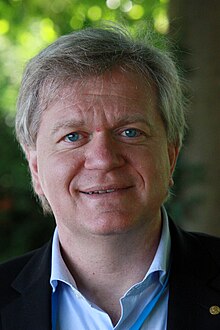 |
| This guy is my teacher. And yeah, he's got a Nobel, sure. Doesn't yours have one too? |
Even more so when it's not one course − but four. And not wimpy five-week courses either; no, full-fledged, deep-down, 10-week courses each. A grand total of 40 weeks of tutelage about the finer points of recent astrophysics research, from some of the best-regarded players in the field. So, yeah, I registered for ASTRO1 and ASTRO2 (Exoplanets, due this summer).
So, six weeks into the whole 10-week kaboodle, what to think about it?
First off, it would be unfair to say this is a course by Brian Schmidt. I mean, it is. But it's co-authored and co-hosted by one Paul Francis who should take at least as much credit as Schmidt for the course, and possibly more, if only for his awesome[1] participation on the course discussion forums and his award-worthy dress sense.
 |
| I want a waistcoat like this one. |
So, what about the course itself? It's brilliant. As expected, I'm struggling a bit. Some notions I seem not to be able to commit to long-term memory. As often, I get the qualitative aspects of the science and find the quantitative bits less involving. Since I tend to put this course on the backburner, I tend to do the homeworks late at night, when I'm not at my most, shall we say, fast-thinking. In spite of this, the course is easy. It's introductory, we're spared the worst calculations (we don't get to do much worse than simple Newtonian point mechanics), all the calculations are (sometimes excessively) spelled out. So I guess if I'm having difficulty with the homework, it's only because I don't put in much more than minimal effort. But that's okay, that's part of the deal. (And anyway, I'm just in a huff because I got one question wrong in 5 whole homework assignments. Fear not; I'm still well on my way to get my 10th edX certificate with this course.)
Generally, each week is devoted to a particular unsolved problem, such as the expansion of the Universe, the nature of the first stars (and why we can't see them), quasars, and so on. Noticeably, the lessons make use of very recent data (some readings from last year only were mentioned in week 6), so it gives a good idea of what astrophysicists actually do nowadays.
One particularly brilliant idea is the weekly mystery, the premise of which is: we've been moved to an alternate, parallel universe, that is superficially like ours (the same laws of physics apply) but quite different in some respects (such as, the night sky is full of brightly-coloured bubbles). Each week we're given some information about the mystery universe; the final will, apparently, test how well we've figured it out. That's fun as it is, but the particular stroke of brilliance is that the information we get is that which we ask for on the discussion forums − that is to say, Paul Francis trawls the forums all week long to find out the most frequently asked-for piece of data, then builds the data set (often complete with figures, “photographs” of the bubbly sky, etc.) and gives us the result as the next week's mystery entry. It creates a great dynamic with the class.
It must also be a dreadful amount of work for the staff; I guess the course isn't going to run with this format every year. All the better reason to stick to ASTRO1.
[1] And that's not a word I use lightly.
Catching up on Stat 2.2x
As I wrote in an earlier post, I regret not having taken Stat2.2x from the start. I have since registered, and it's sort of an uphill battle to get back up to speed. I've viewed the videos up to about the halfpoint of week 2 now, and tried my hand at the problem sets (ungraded of course since the deadline is way past.) I didn't do too badly, but not nearly good enough to pass the overall course.
Let's do the calculations:
One needs 50% overall to pass the course. A total of 68.75% is still reachable; so a pass is far from impossible. However probabilities is something I never really developped a good intuition for; this takes time. Rushing through the course (doing in three weeks what's meant to be done in five) may not be the best way to do it.
And of course, it means I have to catch up to week 3 today since the corresponding exercise set is due at 1am tonight, Paris time.
But eh, it's a challenge, right?
About the course, then: Stat2.2x follows Stat2.1x, and everything is kind of the same: the lectures are very long and slow, Prof. Adhikari speaks very slowly (with a lovely accent though) and repeats herself quite a lot. That's deliberate: probabilities is one area in which one really should get an intuition for how to approach problems, and going through the material slowly and deliberately is a good way to build that intuition. Still, when you've understood something, it kind of grates to have it repeated three times over fifteen minutes.
The course logistics are a bit different from other MOOCs: all the lectures are released at once, but the exercise sets are released only at the start of the week under scrutiny. The midterm and final have a rather harsh timeframe, as there are only two days between release and due date, and they're on weekends. Since the final alone is worth half of the overall grade, one may have to choose between passing the course and that romantic getaway to Florence one had planned for months before.
In practice, it means one can quickly watch the whole course's material, then review the relevant material just before the exercise sets / midterm / final when they're released. That means going over the material twice, which helps integrating the knowledge, I find.
With a more forgiving schedule for the exams, it would be a perfect arrangement. But then again, left to my own devices, I'd do away with midterms and finals altogether − but that's a topic for another blog post.
Anyway, I'd better stop procrastinating, and learn stuff about hypergeometric probability distributions.
[EDIT: Yay! Made the 6.25% in time.]
Let's do the calculations:
- there are five exercise sets, the lowest score of which is dropped, worth 25% of the grade together (meaning the 25% are split into 4 ES scores). So each ES is worth 6.25% of the overall grade. Three exercise sets are still available to me, so I can get up to 18.75%;
- last week's midterm was also worth 25% − but that's closed to me now;
- the final is worth 50% of the grade.
One needs 50% overall to pass the course. A total of 68.75% is still reachable; so a pass is far from impossible. However probabilities is something I never really developped a good intuition for; this takes time. Rushing through the course (doing in three weeks what's meant to be done in five) may not be the best way to do it.
And of course, it means I have to catch up to week 3 today since the corresponding exercise set is due at 1am tonight, Paris time.
But eh, it's a challenge, right?
About the course, then: Stat2.2x follows Stat2.1x, and everything is kind of the same: the lectures are very long and slow, Prof. Adhikari speaks very slowly (with a lovely accent though) and repeats herself quite a lot. That's deliberate: probabilities is one area in which one really should get an intuition for how to approach problems, and going through the material slowly and deliberately is a good way to build that intuition. Still, when you've understood something, it kind of grates to have it repeated three times over fifteen minutes.
The course logistics are a bit different from other MOOCs: all the lectures are released at once, but the exercise sets are released only at the start of the week under scrutiny. The midterm and final have a rather harsh timeframe, as there are only two days between release and due date, and they're on weekends. Since the final alone is worth half of the overall grade, one may have to choose between passing the course and that romantic getaway to Florence one had planned for months before.
In practice, it means one can quickly watch the whole course's material, then review the relevant material just before the exercise sets / midterm / final when they're released. That means going over the material twice, which helps integrating the knowledge, I find.
With a more forgiving schedule for the exams, it would be a perfect arrangement. But then again, left to my own devices, I'd do away with midterms and finals altogether − but that's a topic for another blog post.
Anyway, I'd better stop procrastinating, and learn stuff about hypergeometric probability distributions.
[EDIT: Yay! Made the 6.25% in time.]
Saturday, May 3, 2014
Postmortem: Fundamentals of Immunology part 1 at Rice University
Rice University have put up a Fundamentals of Immunology on edX; part 1 is closing right now. I've been quite successful at it with an overall grade of 90%; it's been rather a lot of work to get to that level so I'm rather proud of it. It's also going to be my second Verified Certificate from edX.

A quick note: as I said in the introduction, I paid for the Verified certificate. Not so much because I think the certificate will be helpful in my career (I don't see how it would) but because it's cheap (25 USD, about 20 euros), it's a way to indicate appreciation for the work being done, and it's an added motivator: having paid, I'm less likely to drop the course, even if it's hard work.
[Edit] And now the certificate's arrived!

Immunology?
Yeah, you know; the study of the immune system. White blood cells, lymphocytes, the CD4 receptors that VIH binds to, auto-immune reactions (including allergies), the lot.
I've actually got a vested interest in learning about all that, as a lot of people around me have autoimmune diseases; but it's a fascinating subject in its own right. The downside is that, as most medicine-oriented courses (it's based off a pre-med course at Rice) it's heavy on memorization, so be warned, if you take this course or indeed any other course on Immunology, you better be ready to spend hours revising.
What does the course cover?
This is the first part of a two-part course; I expect most of the really hairy stuff to be in the second part.
First off, the course focuses on the operating principles of the immune system in vertebrates, especially humans. Mice and even birds are mentioned at times, but really, it's all about people.
The course starts with an overview of the different types of pathogens (in ascending order of complexity: viruses, bacteria, single-cell eukaryotes such as Giardia, fungi, worms), then a 30'000-feet-high overview of the immune system(s) in higher organisms (plants, fungi, animals) and the distinction between the innate and adaptive immune systems (the latter being specific to vertebrates). Starting with lecture 2, we dive into the details, with an overview of hematopoiesis (how blood cells are made and how they differentiate) and a long list of white blood cell types (myelocytes, lymphocytes, neutrophils, basophils, dendritic cells, B-lymphocytes, T-lymphocytes, etc.) Lecture 3 is a quick run-down of innate immunity.
Most of the rest of the course focuses on B-lymphocytes, the immune system's antibody factories: how antibodies are structured, how B-cells differentiate, how and where they mature, etc. That takes three whole (and information-dense) lectures. The course finishes with a discussion of the complement system, that is to say the molecular process by which pathogens, once identified by antibodies, are neutralized and killed.
So, quite a lot to fit in 6 weeks of lessons. The estimate of 7-10 hours per week on the course presentation page may be a bit higher than what I actually did, but it's not very far off.
Who is the teaching team?
The lecturer is Dr Alma Moon Novotny. (Don't be fooled by her Russian-sounding name, she has a very strong American accent!) She obviously has a long experience of teaching the subject, and makes a lot of effort to make the “memory load”, as she says, lighter. She does it by way of models, cartoons, and analogies. It's a bit strange at first to have cartoonish characters in the slides for a college-level course, but as soon as you realize that you have to learn the essential characteristics of each of these cells by heart, you start thanking her for the fun way in which everything is presented.
In a similar vein, she is generally funny and jokey (for instance calling the stem part of an antibody the “Yoo-hoo! bit” since it's the one that summons other cells) and, well, just fun to listen to. This really helps in such a basically arid subject.
 |
| My name is Bond. James "B-cell" Bond. |
What about logistics?
The course lasts for 6 weeks, plus two for wrapping up (review, final exam, grading). Each week is generally taken up by one lecture (three lectures are squeezed in the first two weeks), divided in shortish segments of about ten minutes each. Below each segment are one or two ungraded “fact check” questions to make sure you've understood it all.
The lectures are accompanied by two PDF documents: the lecture outline, and the slides themselves. Dr Novotny recommends using the outline to follow along with the lectures; I've been doing a mix of reviewing the outline before watching the lectures, and following along with the slides. The outlines and slides are a great help for reviewing; to prepare for the quizzes and final exam I eventually printed them all out and carried them around everywhere.
(Phew, revising lessons on the bus: hadn't happened to me in fifteen years!)
A quiz wraps up each week. Somewhat unusually for MOOCs, the quizzes are “closed-book”, which is to say you're not supposed to have the course material (or indeed anything else) at hand while taking them. There's no way to enforce the policy though, so it's all a matter of honour on the students' side. (To be perfectly honest, I hadn't understood they were closed-book until the third quiz. Note however that I didn't actually get much better grades on the first two, when I had the outlines etc. at hand, than on the other four or indeed the final exam, for which I did adhere to the closed-book policy).
The course is wrapped-up with a longish 60-question final exam covering the whole course, also closed-book.
 |
| One question per page… doesn't quite mesh with the edX navigation system |
As usual for MOOCs, there is no textbook (which is why the outlines are so detailed). Dr Novotny does provide a handful of links to interesting resources on the Internet though; while revising, I found (as she mentions) that the relevant Wikipedia pages are actually very good.
My impressions
I enjoyed the course a lot. First because I learned a lot of stuff, then because Dr Novotny is simply a joy to listen to.
The less enjoyable parts were, of course, the quizzes. I doubt there's anybody on Earth who actually likes doing quizzes… It didn't help that some of them were mis-coded (this was obviously the first run of the course and the staff obviously had to get to grips with the edX platform; they were, however, very responsive whenever errors were flagged on the forums). We're evidently far from the very sophisticated 7.00x Introduction to Biology from MIT with its wealth of interactive tools instead of simple yes/no/maybe quizzes. However, it's also obvious the Rice team hardly had the same budget as the MIT one's for producing the course − and it would be unfair to decry the course for not being up to the very best course I've ever seen. This Immunology course is all that can be reasonably expected, and more.
 |
| Dr Novotny with an antibody |
A quick note: as I said in the introduction, I paid for the Verified certificate. Not so much because I think the certificate will be helpful in my career (I don't see how it would) but because it's cheap (25 USD, about 20 euros), it's a way to indicate appreciation for the work being done, and it's an added motivator: having paid, I'm less likely to drop the course, even if it's hard work.
Overall, I'm eagerly anticipating part 2 (where we'll learn all about T lymphocytes). Do be warned though, if you want to take up this course: it's a lot of work, and a lot of it is unfortunately (but unavoidably) about memorizing stuff.
[Edit] And now the certificate's arrived!
Friday, May 2, 2014
Fifo goes to eleven

I'd uncork the champagne, only I haven't got any at home (and anyway alcohol doesn't mix very well with the painkillers).
Sunday, April 27, 2014
Dropping PH525 - Data Analysis for Genomics
Yesterday I wrote that it was "extremely unlikely I [would] get a certificate" for that course.
Well, it's official: I'm dropping out of PH525 - Data Analysis for Genomics (from Harvard via edX). It's not that the material is bad in any way; I just can't commit the necessary time and attention to the course. It's too close to what I'm doing with MIT's Analytics Edge class; there's only so many hours I can do R in a week.
Besides, next week (aka "tomorrow") I start both the Epigenetics course at Melbourne University and the MongoDB Advanced Operations course at MongoDB. If I'm already struggling to watch the Harvard lectures now, I dare not think what it will be in a few days.
So, well. I'll watch for repeats (or watch the archived course in due time).
Subscribe to:
Posts (Atom)