The Australian National University in Canberra have an astrophysics course up on edX called “
Greatest Unsolved Mysteries of the Universe”.
I have to admit I only registered when I figured that one of the lecturers − one Brian Schmidt − was a Nobel Prize laureate. I mean, I enjoyed
A brief history of time and all, but truth be said, I'm not so much into astrophysics as all that, what with juggling between extremely large quantities (uh, how many
megaparsecs did you say?) and extremely small quantities (like, what's an
electronvolt?) and generally complex physics. You have to remember, I never really studied physics beyond Newton, Maxwell and Bernoulli. I have a nodding acquaintance with relativity through reading a lot of sci-fi, but in my vocabulary, “quantum” is a passable synonym for “magical”. Still, getting a course from a Nobel prize winner is an opportunity one never really should pass on, if only for bragging rights.
 |
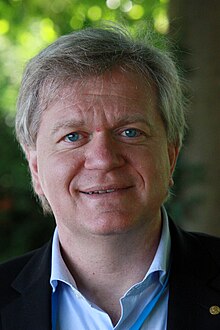
| This guy is my teacher. And yeah, he's got a Nobel, sure. Doesn't yours have one too? |
Even more so when it's not
one course − but
four. And not wimpy five-week courses either; no, full-fledged, deep-down, 10-week courses each. A grand total of 40 weeks of tutelage about the finer points of recent astrophysics research, from some of the best-regarded players in the field. So, yeah, I registered for ASTRO1 and ASTRO2 (
Exoplanets, due this summer).
So, six weeks into the whole 10-week kaboodle, what to think about it?
First off, it would be unfair to say this is a course by Brian Schmidt. I mean, it is. But it's co-authored and co-hosted by one Paul Francis who should take at least as much credit as Schmidt for the course, and possibly more, if only for his awesome[1] participation on the course discussion forums and his award-worthy dress sense.
 |
| I want a waistcoat like this one. |
Francis' fast, excitable delivery is also very engaging, but I guess that's subjective. Based on
his personal page on ANU's website, he's been quite involved in outreach programmes, and won several awards for science teaching; basically, it shows.
So, what about the course itself? It's brilliant. As expected, I'm struggling a bit. Some notions I seem not to be able to commit to long-term memory. As often, I get the qualitative aspects of the science and find the quantitative bits less involving. Since I tend to put this course on the backburner, I tend to do the homeworks late at night, when I'm not at my most, shall we say, fast-thinking. In spite of this, the course is
easy. It's introductory, we're spared the worst calculations (we don't get to do much worse than simple Newtonian point mechanics), all the calculations are (sometimes excessively) spelled out. So I guess if I'm having difficulty with the homework, it's only because I don't put in much more than minimal effort. But that's okay, that's part of the deal. (And anyway, I'm just in a huff because I got one question wrong in 5 whole homework assignments. Fear not; I'm still well on my way to get my 10th edX certificate with this course.)
Generally, each week is devoted to a particular unsolved problem, such as the expansion of the Universe, the nature of the first stars (and why we can't see them), quasars, and so on. Noticeably, the lessons make use of very recent data (some readings from last year only were mentioned in week 6), so it gives a good idea of what astrophysicists actually do nowadays.
One particularly brilliant idea is the weekly mystery, the premise of which is: we've been moved to an alternate, parallel universe, that is superficially like ours (the same laws of physics apply) but quite different in some respects (such as, the night sky is full of brightly-coloured bubbles). Each week we're given some information about the mystery universe; the final will, apparently, test how well we've figured it out. That's fun as it is, but the particular stroke of brilliance is that the information we get is that which we ask for on the discussion forums − that is to say, Paul Francis trawls the forums all week long to find out the most frequently asked-for piece of data, then builds the data set (often complete with figures, “photographs” of the bubbly sky, etc.) and gives us the result as the next week's mystery entry. It creates a great dynamic with the class.
It must also be a dreadful amount of work for the staff; I guess the course isn't going to run with this format every year. All the better reason to stick to ASTRO1.
[1] And that's not a word I use lightly.